

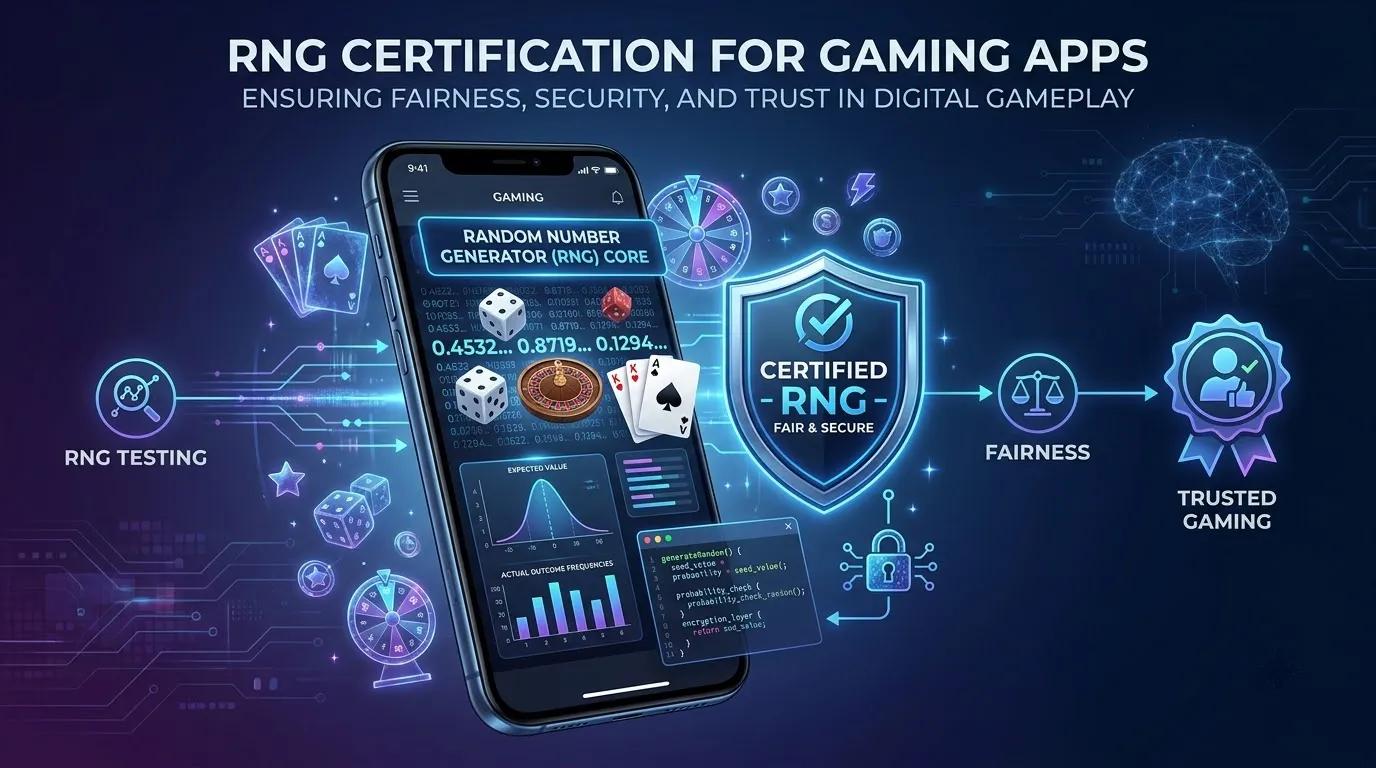
RNG certification for gaming apps
Online gaming has undergone a significant transformation with the rise of mobile applications, web-based games, and real-money gaming platforms. With the shift toward online platforms, the integrity of the game outcome has become a critical concern for both players and operators.
This is where RNG certification for gaming applications comes in.
A Random Number Generator (RNG) is a device or algorithm designed to generate a sequence of random values, which can influence the outcome of various casino games like slots, poker, roulette, lottery, and other games of chance.
An RNG audit confirms whether a given random number generator meets the minimum technical and statistical standards. Additionally, such a review may involve an examination of the source code, statistical analysis, or inspection of the process of mapping or scaling random numbers to game results.
What Is RNG Certification?
RNG certification is a conformity assessment of the random number generator implemented in a gaming application performed by an independent testing laboratory. The assessment aims to identify potential flaws, biases, non-randomness, or other irregularities that could compromise the integrity of the RNG or its outcomes.
The requirements for testing and certifying RNGs vary across different jurisdictions, games, technologies, and standards. For example, gaming standards can involve statistical testing, code review, and analysis of the random number generation process.
In short, certification should not be considered a binary yes/no or pass/fail result. Instead, it is a conformity assessment of a defined scope based on specific criteria.

Why RNG Certification Matters for Gaming Apps
Players are not aware of what happens in the software that implements an online game. In a card game, the shuffling of real cards is visible to all. In a computer game, this process runs inside the application.
Independent RNG testing helps ensure that results really are random while providing certification that satisfies regulatory requirements and meets the needs of gaming platforms.
Testing methods must therefore check that a given program implements randomness in compliance with relevant standards, such as statistical randomness, distribution characteristics, and independence of results. According to GLI, source-code reviews and statistical analysis are part of the standard RNG audit process.
What Does an RNG Test Check? Essay
The test can include different aspects.
1. Source Code Review
Testing laboratories can examine the source code of the RNG, its scaling and shuffling processes, and other aspects that affect the final result.
The main goal is to find implementation flaws, bias, or other issues that impact the outcome of a game. In particular, GLI’s interactive gaming standard includes source-code review as part of RNG testing.
2. Statistical Testing
Statistical analysis can be used to check if the RNG produces a pattern of numbers that are not expected.
It is necessary to analyze the results of the RNG’s operation in order to find any deviations. In addition, different statistical tests are used, which may vary depending on the specific characteristics of the RNG.
3. Seeding and Re-Seeding
The process of seeding and re-seeding can also be subject to testing.
This is important because improper implementation of these processes can allow an attacker to predict the outcome of a game with high accuracy.
4. Scaling and Shuffling
The process of scaling is also subject to testing, since it is this process that selects the final value from a set of possible values. In addition, the shuffling process is subject to testing, since the RNG output must be random in all areas. These two processes are important because they can affect the final result of the game. Testing laboratories can analyze both the raw RNG output and the final value after scaling.
RNG Certification Is Not the Same as Full Game Certification
The main point to remember is that certification of a random number generator does not necessarily mean that the whole gaming application is certified.
The RNG audit covers only one particular aspect of the gaming application, while other elements, such as mathematics, rules, payouts, RTP, security, and technical aspects, need to be evaluated in a separate certification process.
For instance, an iTech Labs certificate refers to the RNG certification as a ‘partial certification’, which means that only the random number generator has been tested and approved, while the rules and payouts should be evaluated in a different audit procedure.
How the RNG Certification Process Works
Although there may be some differences, a certification process generally involves several steps.
First, the developer should provide the RNG implementation, documentation, source-code information, and testing environment.
Then, the testing laboratory will analyze the provided information and define the scope of testing.
The RNG is tested technically and statistically.
If errors are found, the developer has to make necessary changes to the implementation and resubmit it for testing.
For instance, the submission guidelines developed by GLI require providing the relevant application, game parameters, data-capture utilities, source-code documentation, hardware specification, and other information.
After testing, the laboratory issues a report or certificate about the performed conformity assessment.
Reasons Why Developers Should Prepare for Testing
Preparation can make the certification process more efficient.
Gaming developers should establish comprehensive technical documentation and ensure that the RNG under evaluation is identical to the one that will be used in production;
According to GLI, the application under test should be as close as possible to the final implementation in terms of relevant functions, calling sequences, variables, and scaling methods;
It is also essential that developers research the target market ahead of time, as different regions often have divergent technical requirements.
Choosing the Right Testing Approach
There is no one-size-fits-all certification approach for gaming apps.
Developers should consider the following factors to choose the most relevant testing approach:
The type of gaming application
The target jurisdiction or countries
Technical standards applicable in the selected jurisdiction(s)
The type of RNG (random number generator) used in the application (software, hardware, or hybrid)
The scope of testing required
Additional certification requirements specific to the game
This will help them avoid failures due to choosing the wrong testing approach.
How RNG Certification Builds Trust
Trust is especially important in the field of online gambling, where players are relying on technology not under their direct control.
Independent testing does not eliminate all risks associated with a gaming platform, but it can offer objective evidence that a specific RNG has been subjected to testing procedures according to certain criteria.
That, in turn, serves to benefit both the companies developing games, as well as players, who are seeking to ensure they deal with honest and trustworthy operators.
Final Thoughts
RNG certification for gaming applications is an important procedure to ensure the trustworthiness of games with a random outcome.
Although it usually involves source-code testing, statistical evaluation of algorithms, seeding, shuffling, or other factors, certification is not a universal solution to verify each element of a gaming application.
On the contrary, a certified RNG is a significant part of the whole process with a set of required procedures to meet specific standards.
Therefore, gaming operators need to evaluate potential jurisdictions with corresponding standards, collect relevant documents, and establish cooperation with independent laboratories to complete the required procedures.
In doing so, random number generators tested under technically reliable conditions become an integral part of an organization’s product.